


Your shopping cart is empty!
Garden arrach "Magenta Magic" (French spinach, garden orache, mountain spinach)
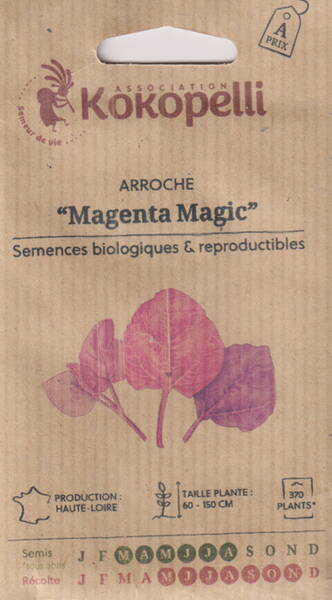
Eco seeds
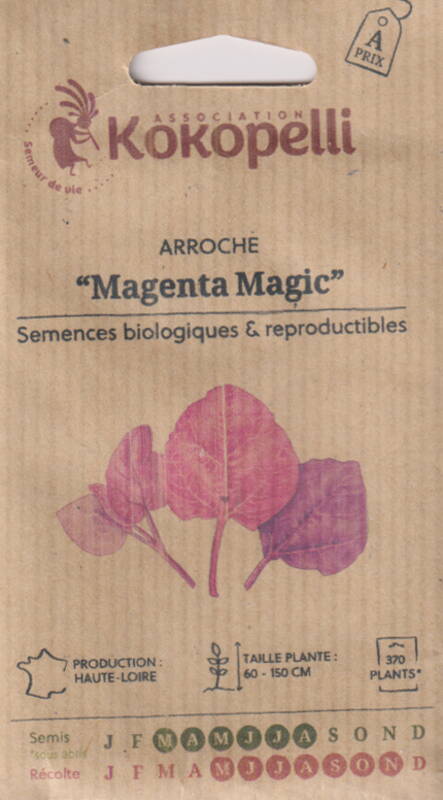
Atriplex hortensis var. rubra
3.53€
Ex Tax: 2.85€
Ex Tax: 2.85€
Garden Orache - Atriplex nitens = Atriplex hortensis.
A plant up to 1.5 m tall. Plants are slender, not very branched, compact. They are ornamental from the moment of emergence until the end of fruiting.
The underground organ is a taproot. Leaves and shoots are red-burgundy. There are green-leaved forms. Flowering is from mid-summer, flowers are small, inconspicuous, not very decorative. Edible.
Seeds are large, light. There are up to 150 seeds in 1 g. To get 100 plants, 1 g of seeds is needed. Currently, several ornamental varieties of garden orache are known, which are grown as annuals.
Location: any, except shade. The plant is drought-resistant and thermophilic.
Soil: undemanding, any garden soil.
Care: weeding, moderate watering, loosening.
Propagation: sow in a permanent place in clusters of 2-3 seeds at a distance of 25-30 cm. The sowing time is chosen so that the seedlings are not damaged by frost, usually in late May. Seeds germinate amicably, in 6-8 days. If plants with ripened seeds are not removed, it gives abundant self-seeding. Seed viability: 2-3 years.
Use: valued for their large, brightly colored leaves and stems. Small groups or high borders are especially effective. Oraches can be trimmed, creating dense walls or screens for other plants. Inflorescences of orache can be dried and used in the composition of dried flower arrangements. These are excellent background plants that shade the flashy beauty of other flowers and give volume to arrangements.
A plant up to 1.5 m tall. Plants are slender, not very branched, compact. They are ornamental from the moment of emergence until the end of fruiting.
The underground organ is a taproot. Leaves and shoots are red-burgundy. There are green-leaved forms. Flowering is from mid-summer, flowers are small, inconspicuous, not very decorative. Edible.
Seeds are large, light. There are up to 150 seeds in 1 g. To get 100 plants, 1 g of seeds is needed. Currently, several ornamental varieties of garden orache are known, which are grown as annuals.
Location: any, except shade. The plant is drought-resistant and thermophilic.
Soil: undemanding, any garden soil.
Care: weeding, moderate watering, loosening.
Propagation: sow in a permanent place in clusters of 2-3 seeds at a distance of 25-30 cm. The sowing time is chosen so that the seedlings are not damaged by frost, usually in late May. Seeds germinate amicably, in 6-8 days. If plants with ripened seeds are not removed, it gives abundant self-seeding. Seed viability: 2-3 years.
Use: valued for their large, brightly colored leaves and stems. Small groups or high borders are especially effective. Oraches can be trimmed, creating dense walls or screens for other plants. Inflorescences of orache can be dried and used in the composition of dried flower arrangements. These are excellent background plants that shade the flashy beauty of other flowers and give volume to arrangements.
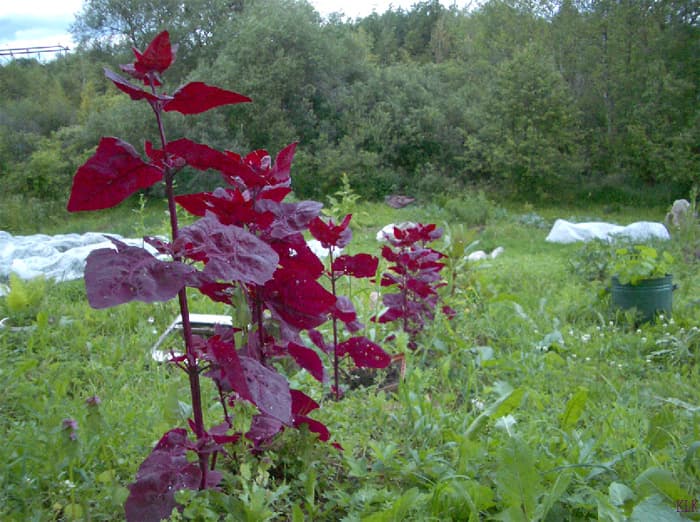
* Garden Orache (Atriplex hortensis).
Family: Amaranthaceae.
Habitat: in vegetable gardens, wastelands, near housing, on streets, in crops, in the steppe along river banks, on slopes and ravines.
Culinary use: leaves — like spinach; leaves and young shoots for boiling, stewing, pickling, marinating; in old times — for baking bread.
Harvesting time (shoots and leaves): May-June.
Orache leaves contain proteins, a complex of vitamins, and substances useful for the gastrointestinal tract. The same dishes are prepared from orache as from spinach, using it fresh, boiled, stewed, canned, and dried for preparing salads, soups, purees, and side dishes.
Garden orache has long been used as a medicinal plant. For liver diseases, young boiled orache is eaten. A decoction of leaves and flowers of garden orache is a good remedy for coughing accompanied by viscous sputum. External emollient poultices from orache relieve joint pain in gout and relieve the soreness of hemorrhoidal bumps. Orache can be sown for food and medicinal purposes in several terms: in spring, in June, and in early August, burying seeds to a depth of 1 cm. Orache crops are regularly watered before germination. Garden orache is harvested when 5-8 true leaves develop, before the appearance of peduncles, at a height of 25-40 cm (early in the morning the young plant is pulled out entirely).
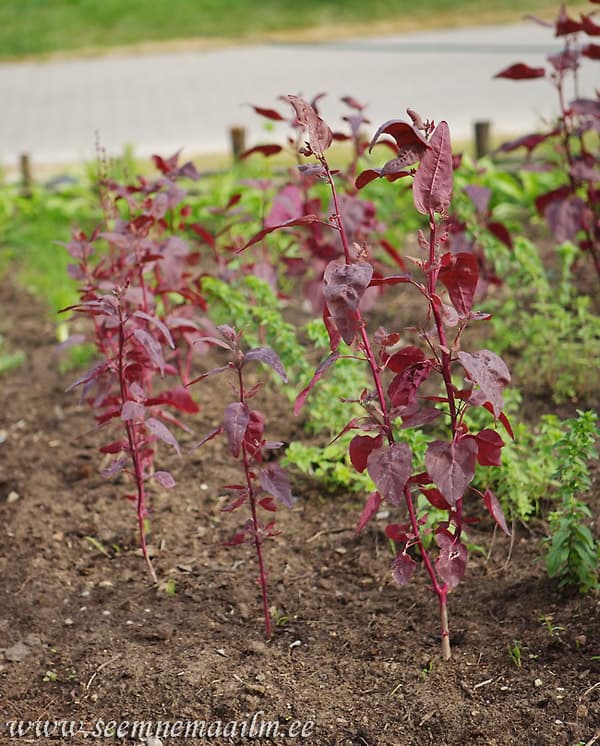
* Atriplex is a large genus of annual and perennial herbs, semi-shrubs, and shrubs of the Amaranthaceae family. Often plants are covered with silvery hairs, making them look as if sprinkled with flour. Previously, orache was assigned to the Chenopodiaceae family, which is not surprising (now this family is fully included in Amaranthaceae).
Goosefoot (Chenopodium) can look like Orache (Atriplex) like two peas in a pod, so even a specialist will not always say immediately who is in front of him without looking closely. Orache can be easily distinguished from goosefoot by the fruits. In orache, the seed is surrounded by two fused bracts and, thus, is as if packed in a bag. Often the edges of the bracts grow, forming wings.
In goosefoot, the seeds are "naked", spilling out of the inflorescence. They also differ in the structure of flowers, but this is more complicated, a magnifying glass is indispensable here. In orache, not all flowers are the same, some have no stamens, while in goosefoot, all have stamens and pistils.
In culinary terms, orache is more tender and juicy than goosefoot, but its leaves are smaller, so it is more convenient to eat it right with the twigs. In addition, it must be taken into account that goosefoot contains a large amount of oxalic acid salts, which is unsafe for people suffering from kidney stone disease. But orache does not contain such salts. Moreover, many types of orache are used as medicinal — sedative, diuretic, some even in the treatment of tumors; seeds have a strong emetic and laxative effect.
Leaves and young shoots of many types of orache are used raw, boiled, pickled, and fermented: Long-stalked Orache (Atriplex calotheca), Grey Sagesh (Atriplex cana), Garden Orache (Atriplex hortensis), Grass-leaved Orache (Atriplex littoralis), Small-flowered Orache (Atriplex micrantha), Common Orache (Atriplex patula), Spear-leaved Orache (Atriplex prostrata), Tumbling Orache (Atriplex rosea), Shining Orache (Atriplex sagittata), Siberian Orache (Atriplex sibirica), Tatarian Orache (Atriplex tatarica) — one cannot list them all...
Leaves of grass-leaved, common, garden, and shining orache are used as a spinach substitute. However, garden orache most often gets into cooking as the tastiest (or rather, the least tasteless) of all relatives. It grows both in the wild and in vegetable gardens where it is grown to this day, especially in more southern regions.
The most common orache here is the Common Orache (Atriplex patula). Unlike the grayish-bluish goosefoot, it is dark green. Lower leaves are often lanceolate, with an arrow-shaped base, toothed, with upward-pointing ears. The petiole is short, 5-8 times shorter than the blade. The lower and middle leaves are always directed downwards, as if the plant had withered. Bracteoles at fruits look like a spearhead. Plant height 30-90 cm. It usually grows in vegetable gardens, wastelands, weedy places, streets, and river banks.
Garden orache is an annual plant with an erect branching stem from half a meter to almost 2 m, depending on the variety and soil. Leaves are different in shape, oblong, thin, and slightly sour in taste. Flowers are small, greenish, whitish, or reddish, depending on the color of the plant's foliage. Orache seeds are small, black, surrounded by a thin, pale yellow film-membrane.
Garden orache comes to the table more often from vegetable gardens than gathered in the wild. It was widespread in the Mediterranean since ancient times until it was displaced by related spinach.
Leaves of cultivated garden orache are, like "wild" ones, red, white, and green. Red orache is more often used as an ornamental plant - its high growth and bright coloring attract attention from afar.
White orache is a vegetable plant used in borscht, cabbage soup, side dishes. Its leaves are large, palm-sized, very soft and juicy. Usually, white orache is grown instead of spinach as its thermophilic alternative when one wants to use its greater resistance to heat. Green orache (leaves) is used to color pasta in Italy.
In general, young shoots and non-coarse leaves of orache are eaten boiled like spinach, put in vinaigrettes, sauces, together with sorrel — in cabbage soup (to neutralize the sour taste of sorrel). A salad can be prepared from orache scalded with boiling water. For future use, young shoots are fermented like cabbage and eaten with vegetable oil. Young leaves, shoots, and inflorescences are used for food fresh, fermented, pickled, and dried. Salads are prepared from fresh leaves, in addition, they are boiled and mashed into puree.
In years of famine, orache was used for food not only by Slavs but also by Romans, Greeks, French. Different types of orache saved the lives of thousands of Leningraders in the spring of 1942. But the famous bread from "orache" was actually made not from it, but from the seeds of White Goosefoot (Chenopodium album), which everyone then also called orache.
Eng.: Garden arrach, French spinach, garden orache, mountain spinach, orache, ruby orach mountain spinach. Bot. syn.: Atriplex nitens.
Dried Orache.
Dry collected young plants by spreading them out or hanging them in bunches in the open air (in the wind or in the sun). You can dry them in an electric dryer at a low temperature, cut into suitable lengths. Store in glass jars or wooden boxes lined with paper. Scald with boiling water before consumption.
Salted Orache.
Wash and dry young shoots and leaves. Place in a container, sprinkling with salt (for a bucket of greens - 1 cup of salt). Cover with a wooden circle or a plate with a weight, put in a cool place. After the mass settles, you can add fresh leaves. Wash and chop before use. Can be used for dressing soups.
Spicy Marinated Orache.
Put bay leaf, cloves, cinnamon, allspice, salt, sugar in vinegar and boil. Dip washed orache greens into it and boil again for 10 minutes. Then remove the orache, pack tightly while hot into clean sterilized and hot jars and pour the marinade in which it was boiled over the top. Roll up the lids.
For 1 kg of orache greens: vinegar (2-3%) - 2.5 cups, allspice (peas) - 1 g, bay leaf - 5 g, salt - 15 g, cinnamon - 5 g, cloves (buds) - 2 g.
Orache and Green Onion Salad.
Wash young orache leaves, boil, dry slightly, chop, salt and mix with finely chopped green onions. Season with vegetable oil and any hot sauce.
Orache leaves - 200 g, green onions - 5-6 feathers, vegetable oil and hot sauce - to taste.
Orache and Beet Salad.
Place washed and chopped young orache leaves on slices of boiled beets, salt and season with vinegar and sour cream.
Orache leaves - 100 g, boiled beets - 150 g, sour cream - 20 g, vinegar - to taste.
Potato Salad with Orache Greens.
Boil potatoes until tender, cut into cubes, pour hot broth over and let it soak. Wash orache, dry, chop coarsely. Cut onions into rings, radishes and cucumbers into circles. Mix everything, pour over with a mixture of oil and vinegar. Orache can be replaced with amaranth or mallow leaves, goutweed, but they must be scalded with boiling water beforehand.
Orache (leaves) - 250 g, potatoes - 500 g, bouillon cube broth - 0.5 cup, onion - 1-2 pcs., radish - 1 bunch, cucumber - 1 pc., green onion (chopped) - 0.5 cup, dill - 1 bunch, vegetable oil - 50 ml, vinegar - 4 tbsp., salt and ground black pepper - to taste.
Orache Caviar.
Clean orache, boil, pass through a meat grinder. Finely chop the onion and fry until transparent, put orache into it. Dip tomatoes in boiling water for half a minute, peel, finely chop and put into the mixture of orache and onion. Stew together for 10-15 minutes. 5 minutes before the end, add oregano powder. Turn off, add crushed garlic, cover with a lid and cool. Tomato paste can be added instead of tomato.
Orache leaves and young shoots - 400 g, onion - 1 pc., vegetable oil - 2 tbsp., tomato - 3 pcs. (or tomato paste - 2 tbsp.), oregano (dried) - 1 tsp., garlic - 1 clove, salt - to taste.
Cold Orache Soup.
Wash young orache leaves and sorrel, chop, boil in salted water until tender and cool. Before serving, add finely chopped green onions, fresh cucumbers, dill and season with sour cream.
Young orache leaves - 100 g, sorrel - 30 g, salted water - 2 cups, green onion - 20 g, cucumbers - 40 g, dill - 5 g, sour cream - 20 g.
Orache Shchi (Cabbage Soup).
Rinse orache with cold water. Dip in boiling water, boil until soft, discard in a colander, squeeze, rub through a sieve, add flour and butter and, salting, fry the resulting mass, then dilute it with hot water or broth.
Young orache leaves - 400 g, flour - 1 tbsp., butter - 0.5 tbsp., broth or boiling water - 0.7 l, salt - to taste.
Sorrel and Orache Puree Soup.
Boil young shoots of orache and sorrel leaves until soft, discard in a colander, wipe or pass through a meat grinder (blender), combine with the broth. Chop carrots and onions and fry in butter. Then salt and pepper the soup and let it boil.
Orache - 100 g, sorrel - 50 g, carrots - 50 g, onion - 30 g, flour - 20 g, butter - 50 g, salt and ground black pepper - to taste.
Borscht with Orache.
Cut beef into small pieces and put in a saucepan with water. Bring to a boil, skim off the foam and cook with the lid closed on low heat for 45 minutes.
Wash orache, separate leaves from stems and cut into small strips. Peel potatoes and cut into small pieces, add to the pan, bring to a boil over high heat, salt, reduce heat and cook for 15 minutes until potatoes are soft.
Peel beets, carrots and onions, grind in a blender or finely chop and fry in vegetable oil for 4-5 minutes. Add tomato paste, stir and cook for 10 minutes under the lid, stirring several times. Pour the fry and orache into the pan with meat and potatoes. Pepper, add lemon juice. Cook over low heat for 5 minutes. Serve with sour cream and herbs.
Orache - 120 g, beef - 250 g, water - 1.5 l, potatoes - 4 pcs., onion - 1 pc., carrot - 1 pc., beet - 1 pc., tomato paste - 2 tbsp., vegetable oil - 20 ml, lemon juice - 1 tbsp., salt and ground black pepper - to taste.
Orache Bitki (Patties).
Wash orache, chop and, putting in heated oil, keep on low heat until color changes and all water evaporates. Prepare a liquid dough from milk, flour, 1 tbsp. of oil, finely grated cheese and eggs. Let stand for 1 hour, combine with chopped orache. Take the dough with a spoon and fry in highly heated fat until a golden crust forms.
Orache - 1 kg, milk - 1 cup, flour - 2 cups, grated cheese - 100 g, egg - 3 pcs., vegetable oil - 3 tbsp., fat for frying.
Orache Meatballs.
Place all greens in a blender and chop to a more or less homogeneous mass. Add ground spices. Form meatballs and put them in the refrigerator for 1 hour. If you add a cup of walnuts, 1 tbsp. of apple cider vinegar and a little chili pepper to the blender, and pre-boil the greens, you will get pkhali.
Orache - a large bunch, cilantro - 1 bunch, garlic 1-2 cloves, lemon juice - 1-2 tbsp., olive oil - 1 tbsp., sea salt - 1/4 tsp., ground black pepper, coriander, Provencal herbs and salt - to taste.
Orache Cutlets with Potatoes and Oatmeal.
Steam oatmeal with boiling water, close the container and leave for 30 minutes to infuse. Grate the onion, combine with the swollen cooled oatmeal, add chopped garlic, ginger and spices. Put finely chopped orache into boiling salted water and cook until tender.
Grate potatoes on a fine grater and add to oatmeal. Drain orache and add to the mixture, knead the mass well. Form cutlets, roll in breadcrumbs and fry in vegetable oil until golden brown.
Orache - 150 g, onion - 1 pc., garlic - 1-2 cloves, potatoes - 1 pc., oatmeal - 0.5 cup, breadcrumbs - as needed, salt and spices - to taste.